

I'm coming back home from Rust Week 2026 in Utrecht 🦀. It was two days of interesting and thought-provoking talks, followed by one day of coding together on Rust-related themes.
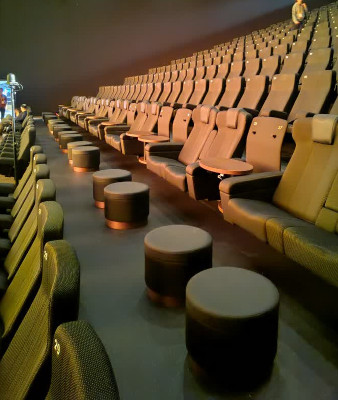
The venue was intelligently chosen: a cinema! No meet up can beat these comfortable human holders:
Talking to the sponsors, they use Rust for all sorts of projects, like developing microchips (Espressif), self-hosted clouds (0xide), a platform for EV chargers in Holland (TandemDrive), data analysis (Polars), GPUs (Vectorware), networking infrastructure (NLNetLabs), and editor (Zed).
I felt shy around the big crowd (I'm working on it...), but I was happy with myself because I've managed to discuss a little with people in different moments of their Rust journey.
I've met many developers using Rust: three for energy grid stability in Germany; one home-lab enthusiast for their projects (no, it was not me!); one that worked on high-frequency trading; one to handle hospital data; another to help configure NixOS.
I've met Denis, who maintains docs.rs infrastructure (❤️). We've discussed server load, storage optimization, and
they teached me a nice shortcut: you can access docs.rs/some_crate:: followed by a search term, and the system
redirects you directly to the search results.
For example, to search for "open" in tokio, try this: docs.rs/tokio::open.
I've also met Josh, who maintains the servo web engine for 14 years. He works literally on the world's second Rust project, the first being the compiler itself. What an inspiring figure!
The ecosystem is very big and innovating, made out of enthusiasts and production users at the same time. And I felt refreshed to hear and talk about passion projects and serious learning, far from the noise of the latest buzzwords mandated by corporate.
The talks
The recordings should be up in a couple of weeks in the official Youtube channel, check if you are curious.
There were 3 parallel tracks, so unfortunately I could not watch them all. From those that I was present, these were my favourites:
- Stabilizing decade-old features by Folkert de Vries
- Writing GPU shaders in plain Rust by Sebastian Sydow
- Untrusted data in Linux — How Rust is going to save us by Greg Kroah-Hartman
- Field Projections — Making Custom Pointers feel Builtin by Benno Lossin and Nadri
- Obsessive Optimization with String Interning by arya dradjica
- Overcoming GitHub shortcomings with Triagebot by Urgau
- Tracking down undefined behaviour in Servo by Josh Bowman-Matthews
The hacking
On the last day, people could hack together on whatever they got nerd-snipped by. The Dutch election council was there and presented their use of Rust in an awesome project: for some years they've put in place a system to help the manual counting of votes by the municipalities and also the final aggregation and seat distribution. Their system is well thought of, it does not aim to replace the manual counting, but instead enhance and verify.
They use public money to create open source. I love the initiative! And it's also efficient: they told that while the previous system produced the final PDF reports in 20 minutes, the new one in Rust runs in less than 1 second!
By law, all election candidates and results must be encoded in XML using the EML-NL format (election markup language). I've worked to reduce the peak memory usage of this data by 30% 🤟🏽.
See you next year, I hope!